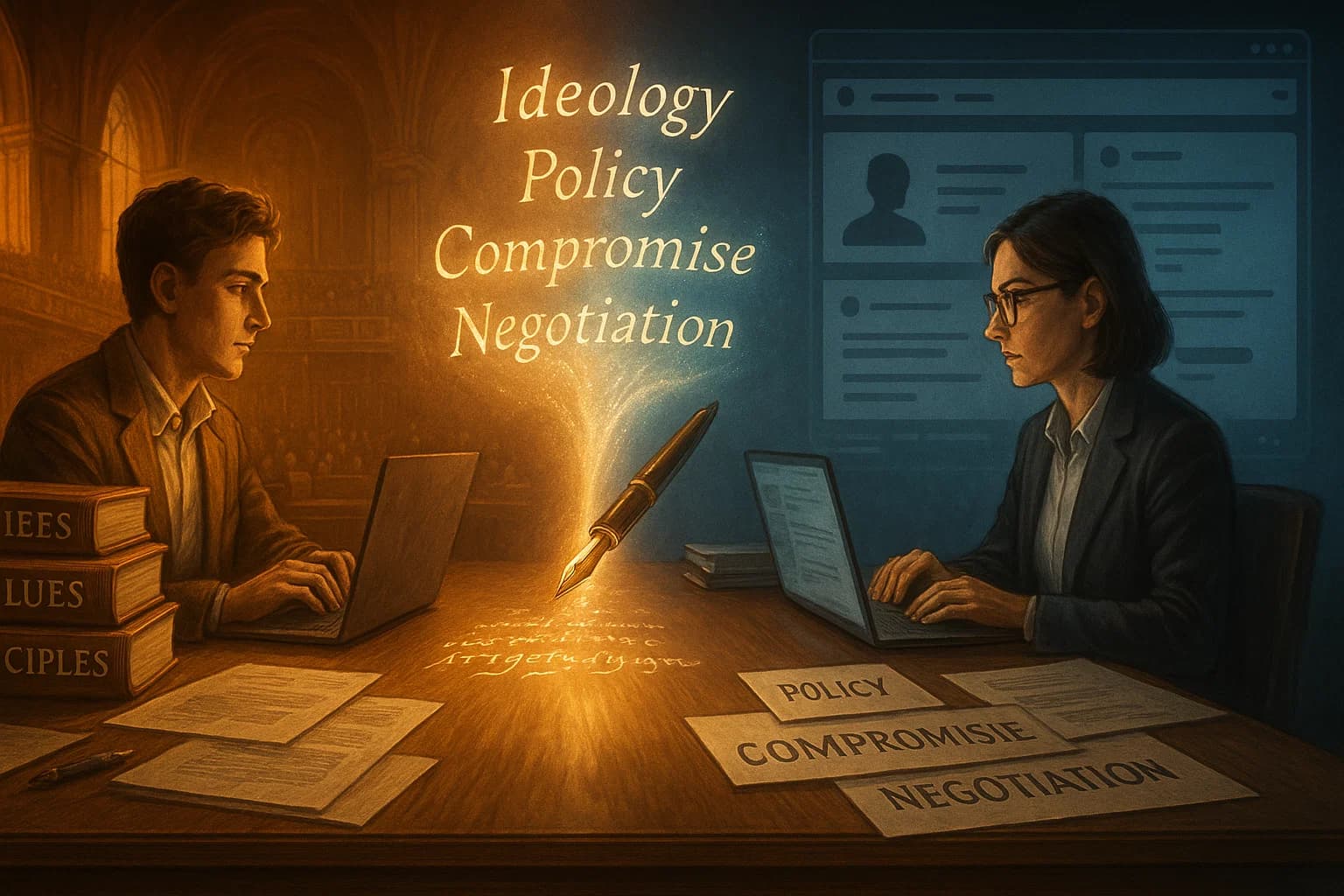
<p>Political life is a perpetual balancing act between the purity of ideas and the messiness of reality. Ideology provides the compass — “a set of interconnected beliefs, values, and principles that individuals or groups hold regarding society’s proper organization and governance” — while practical politics charts the navigable path through shifting winds, rocky terrain, and unforeseen storms.</p><p><br></p><p>The two are not natural enemies, yet they often collide. As the research notes, “ideologies offer coherence, consistency, and guiding principles for political action, while practical politics often requires compromise, flexibility, and adaptation to changing circumstances.” This tension is not merely academic — it shapes every major political decision, every legislative compromise, and every public debate.</p><p><br></p><p>Wribate is designed precisely for this fault line: a digital space where ideological visions and pragmatic realities meet in structured, writing-based debate — slow enough for reflection, rigorous enough for clarity, and respectful enough for cooperation.</p><p><br></p><h2>The Problem: Political Conversations Are Broken</h2><p>Modern political exchanges often reflect what Rectenwald warns against — a “narrow understanding of social issues, where solutions are tailored primarily to address the needs of certain groups while potentially marginalizing or disregarding the concerns of others.” While often well-intentioned, this focus can sideline broader perspectives, fostering identity-driven silos where people engage only with like-minded voices. In such spaces, debate devolves into “soundbite warfare,” prioritizing emotional point-scoring over persuasion, and gradually eroding the shared truths needed for meaningful consensus.</p><p><br></p><p>Meanwhile, as Waldron points out, politics takes place in what he calls the “circumstances of politics” — situations where people strongly disagree but still need to reach a shared decision. In such moments, the goal should be to bridge differences through discussion and arrive at solutions everyone can accept, even if imperfect. Yet today’s political culture often pushes in the opposite direction. Rather than encouraging the slow, difficult work of negotiation and compromise, it tends to reward quick one-liners, public takedowns, and the pursuit of symbolic wins that play well with one’s own side. The result is a system better at producing viral soundbites than durable, principled agreements that can actually guide collective action.</p><p><br></p><h2>Wribate’s Answer: Slowing Down to Think</h2><p>Unlike fast-paced, reactive platforms, Wribate uses an asynchronous, writing-based format. Participants must put thoughts into words — carefully, precisely, and with evidence. This has three powerful effects:</p><p><br></p><ol><li data-list="bullet"><span class="ql-ui" contenteditable="false"></span><strong>Deliberation over reaction</strong> – Echoing Pettit’s call for “a realistic approach to political theory, balancing ideology and practical politics,” Wribate forces participants to slow down, weigh arguments, and respond substantively.</li></ol><p><br></p><ol><li data-list="bullet"><span class="ql-ui" contenteditable="false"></span><strong>Issue over identity</strong> – As Rectenwald cautions, politics should “transcend identity-based divisions and prioritize the common good of all members of society.” Wribate’s debate rules focus on positions, evidence, and reasoning, not personal attacks or identity framing.</li></ol><p><br></p><ol><li data-list="bullet"><span class="ql-ui" contenteditable="false"></span><strong>Structured consensus-building</strong> – as Waldron notes, means “recognizing shared values and aspirations that underpin both ideological beliefs and pragmatic political action.” Wribate’s debate formats create space for this recognition—not by forcing agreement, but by fostering understanding. Even when differences remain, participants leave with a clearer sense of where others are coming from, a respect for the values that shape opposing views, and the possibility of finding common cause without compromising core convictions.</li></ol><p><br></p><h2><strong>Scholarly Foundations, Practical Application</strong></h2><p><br></p><p>The interplay between ideology and practical politics, as the research observes, “reflects the ongoing struggle to reconcile abstract ideals with the realities of governance.” Far from being a flaw in democracy, this tension is its lifeblood.</p><p><br></p><p>Wribate turns these scholarly insights into practice:</p><p><br></p><ol><li data-list="bullet"><span class="ql-ui" contenteditable="false"></span><strong>From Rigidity to Adaptability</strong> – Pettit (2018) reminds us that “true freedom requires not only the absence of coercion but also the absence of arbitrary or unaccountable power.” That freedom demands political engagement that is principled yet flexible — exactly the mindset Wribates cultivate.</li></ol><p><br></p><ol><li data-list="bullet"><span class="ql-ui" contenteditable="false"></span><strong>Beyond Identity Silos</strong> – Rectenwald (2018) warns that identity politics “reinforces divisions within society by emphasizing differences between social groups rather than promoting commonalities and shared goals.” Wribate’s written format rewards depth of reasoning over tribal posturing.</li></ol><p><br></p><ol><li data-list="bullet"><span class="ql-ui" contenteditable="false"></span><strong>Finding the Common Thread</strong> – Waldron notes that “despite apparent differences in ideological positions, political actors often share core values… justice, equality, liberty, and social welfare.” Wribate is built to surface these shared values without erasing the disagreements that make democracy dynamic.</li></ol><p><br></p><ol><li data-list="bullet"><span class="ql-ui" contenteditable="false"></span><strong>Democratic Participation</strong> – Gjorshoski highlights the democratic imperative of “protecting citizens’ rights and freedoms” and ensuring equal participation. Wribate’s coordinated-asynchronous or the harmonized structure means no side/ no one is drowned out by faster speakers or more aggressive personalities.</li></ol><p><br></p><h2>How Wribate Works</h2><p><br></p><p><strong>1. Structured Written Exchanges Over Time</strong></p><p>Wribate replaces the chaos of verbal interruptions with calm, deliberate writing. Participants submit their arguments in well-defined rounds, allowing them to think deeply, research thoroughly, and articulate with precision rather than reacting impulsively.</p><p><br></p><p><strong>2. Equal Opportunity for All Perspectives</strong></p><p>By eliminating the advantage of quick speech, dominating voices, or rhetorical theatrics, Wribate levels the playing field. A university professor and a first-year student can engage on equal terms because clarity of thought—not social status or speaking style—takes center stage.</p><p><br></p><p><strong>3. Empathy Through Gradual Dialogue</strong></p><p>The asynchronous format allows participants to truly absorb opposing viewpoints. Without the rush of live debate, there’s time to reflect, reconsider, and respond thoughtfully—leading to understanding rather than hostility, and fostering a culture of respectful disagreement.</p><p><br></p><p><strong>4.Evidence Emphasis</strong> – Arguments must be backed by data, logic, or credible references, encouraging fact-based reasoning over mere opinion.</p><p><br></p><p>This structure mirrors what Heywood (2021) calls a “framework for understanding societal norms, goals, and aspirations,” allowing ideological clarity to coexist with pragmatic problem-solving.</p><p><br></p><h2>A Digital Institution for Democratic Life</h2><p>Alex Cukierman notes that ideology outlines “the broad, long-term objectives that a nation’s policymakers aspire to achieve,” but policies are “seldom fully realized” because practical considerations dominate implementation. Wribate takes this insight seriously: rather than seeing ideological and pragmatic politics as enemies, it treats them as co-authors in the democratic script.</p><p><br></p><p>This platform operationalizes what Russell Kirk describes as the “balance between change and consistency” — a space where ideas can be tested against reality without being crushed by it.</p><p><br></p><h2>Conclusion: The Wribate Proposition</h2><p>Practical politics- “aims to find solutions to societal challenges that transcend ideological divisions and prioritize the common good.” That is the heart of Wribate’s mission.</p><p><br></p><p>By slowing noisy debate down, privileging the written word, and structuring engagement for fairness and respect, Wribate doesn’t simply host arguments — it cultivates the democratic skill set our moment desperately needs: the ability to listen deeply, argue clearly, and disagree productively.</p><p><br></p><p>Or, as Waldron might put it, Wribate offers a space where, even amid disagreement, we can still make “a common decision in the face of disagreement” — not because we abandon our principles, but because we learn how to wield them wisely in the shared project of governance.</p>